

In researching the roots of the obsession that some intellectual currents have with fabricating “scientific proof” of the existence of immaterial souls that survive death, I always find—besides, of course, the visceral, narcissistic fear of extinction—the same emotional thread: a deeply felt need to refute “materialism.” You can see it in the works of the theological Newtonians we discussed last week; it’s in the preoccupations of the founders of the Society for Psychical Research, the first organization dedicated to the scientific investigation of survival after death; it’s in Arthur Conan Doyle’s sermons defending and promoting Spiritualism.
It’s even in the works of J. B. Rhine, the father of modern parapsychology, who is usually credited with separating psychic “science” from religious urges. But in his book The Reach of the Mind, he disparages:
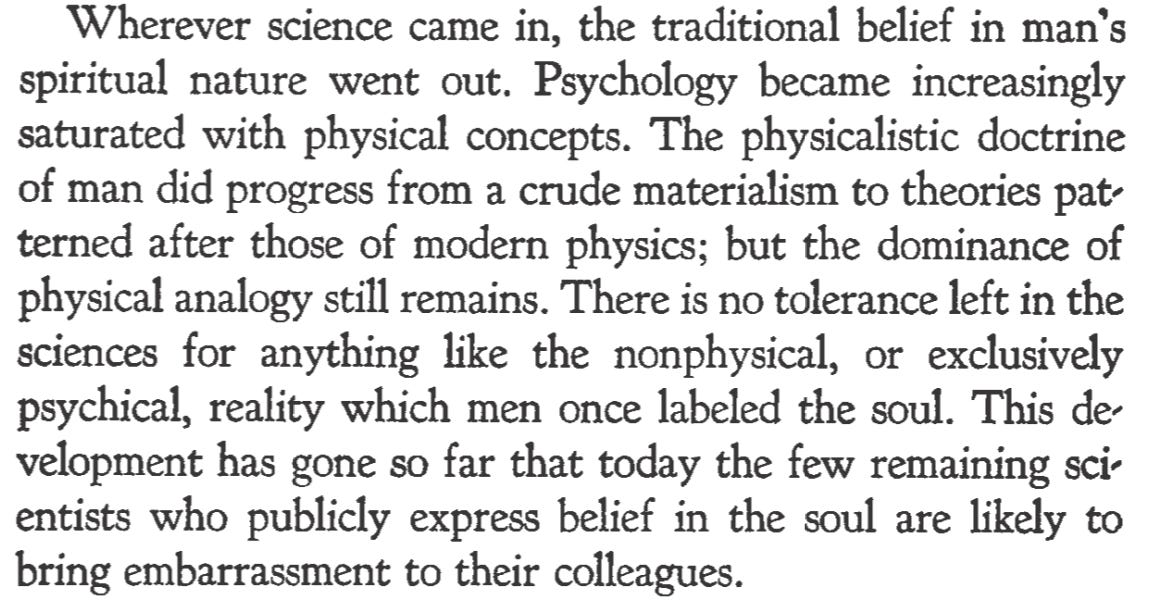
It’s almost Pavlovian: “spiritual” is good, generous, elevated, makes you smile; “materialism” is ugly, crude, superficial, treacherous, it knots up your gut. But, as Carl Sagan used to say, we shouldn’t think with our gut. So what, exactly, is the problem with materialism?
First things first: let’s clear the air a bit and distinguish between what we might call “moral materialism”—the idea that the supreme goal of human life is to pile up jewels, land, and money—and what I’ll call “ontological materialism,” the idea that matter and energy (in the technical sense that physicists use, not the vague, woo-woo mystical sense) are the fundamental basis of everything that exists.
That moral materialism is an aberration has been known at least since Aristotle drew the distinction between means and ends: wealth is a means. That many people turn its accumulation into an end in itself is a serious distortion, but one that in no way affects ontological materialists exclusively. Quite the opposite, actually: just look at how well prosperity cults, well, prosper out there.
The problem is that many people see moral materialism as a kind of logical consequence of ontological materialism: if so-and-so sees nothing in the Universe beyond matter, the reasoning goes, then so-and-so will obviously value only material things.
Yes. Of course. Obviously.
What this line of thinking overlooks, however, is that by dissolving the distinction between the spiritual and the material, ontological materialism also encompasses love, friendship, aesthetic pleasure, culture, and everything else we cherish. All of these become products of matter. Love arising from the activity of neurons and glands is no less love than love supposedly arising from the communion of souls, whatever “communion of souls” might mean beyond a poetic shorthand for “the activity of neurons and glands.”
What remains are the objections that matter is “brute” and “crude,” and that seeing one’s neighbor as a walking matrix of molecules is somehow less dignified than seeing them as a spirit created in the image and likeness of God.
As for the first objection, it is nothing but sheer prejudice. It comes from imagining, whenever the word “matter” is invoked, a rock, a dead animal, or a brick. But fresh flowers and hummingbirds in flight are matter too, as are the delicate clouds of light and gas photographed by the Hubble Space Telescope in the spaces between the stars.
As for the second objection (setting aside, for the moment, the question of which description contains more objective truth), it ignores the fact that, in the materialist view, we are all walking piles of molecules, and that we have, to console our afflictions, only each other—and nothing else.
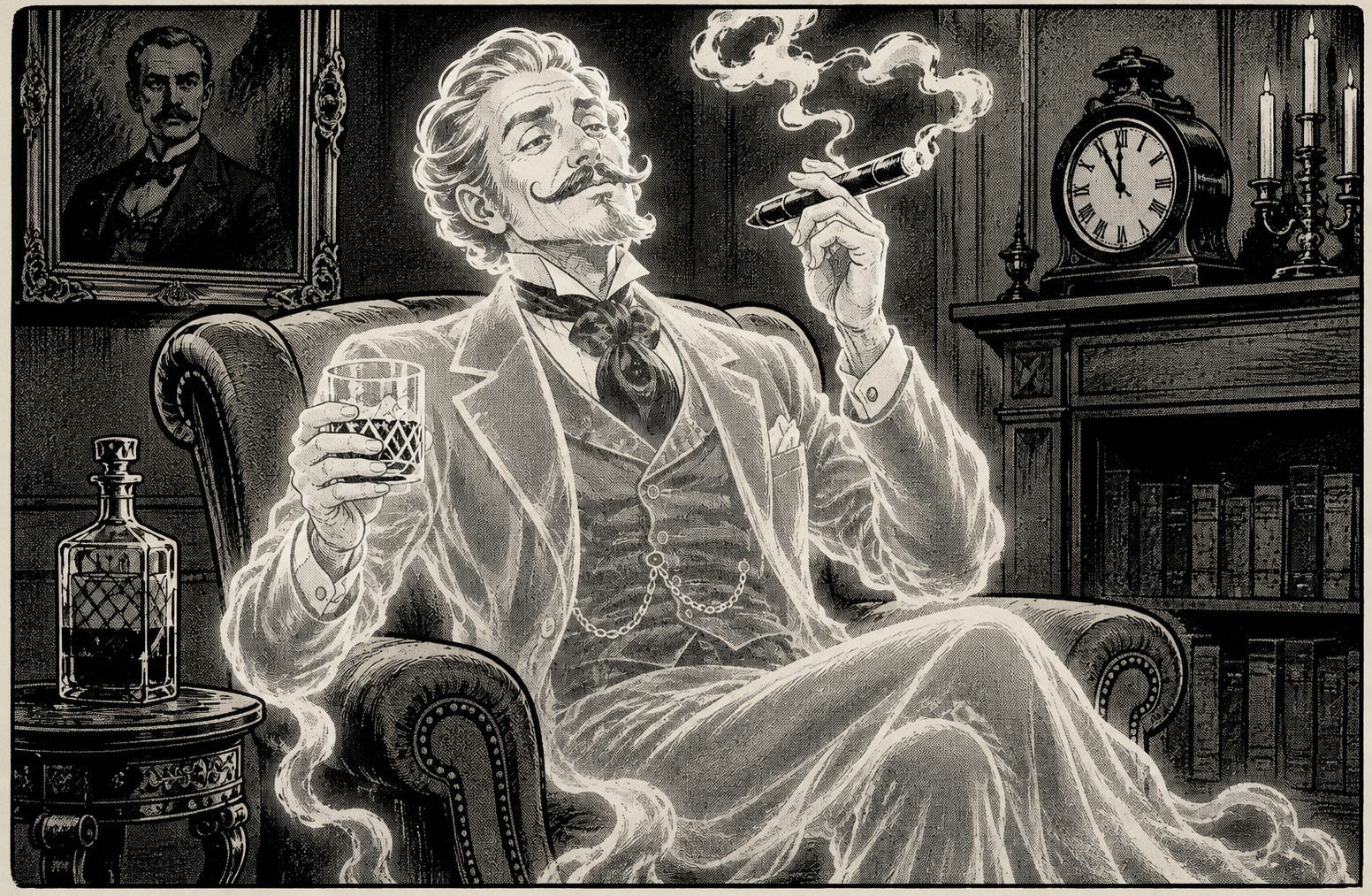
Ironically, almost every single attempt to scientify “spirituality” ends up making the soul into something that is indistinguishable from matter, even if, as Conan Doyle used to say, of an “elevated” or “rarefied” kind. From Emanuel Swedenborg’s visions in the 18th century to the descriptions of the “Summerland”—paradise—brought by spiritualistic mediums in the 19th and 20th centuries, we always get souls that have their own bodies and interact with spiritual “objects” as if they were solid. Physicist Sir Oliver Lodge even published mediumistic dialogues in which spirits describe otherworldly houses of brick, meals, cigars, and whisky. “Spiritual” immortality is, in its own way, a deeply materialistic preoccupation.
(A related point, which most of the time is conveniently overlooked in polite conversation, is the relationship between science and ontological materialism: one way to avoid awkward situations is to say that science “presupposes” materialism, so it can’t really be brought to bear on any discussion of the subject because, of course, that would constitute a circular argument. But it is just not really true: if ontological materialism were empirically inadequate in any way, scientific investigation would eventually hit a wall—the presupposition would suffer a reductio ad absurdum, much as when a mathematician proves a proposition by assuming its negation and then showing that it inevitably leads to a contradiction. Well, in the case of science, materialism has survived all attempts at reductio, and there have been several over the last 600-plus years.)
People who disparage ontological materialism sometimes say they feel vertigo, or despair, or revulsion when faced with the possibility that “there is nothing more.” But if only they could manage their metaphysical loathing for a moment and consider one particular implication: if there’s nothing more, then the love you receive (and give) here is all you get. “Loving thy neighbor” suddenly becomes so much more urgent.
It doesn’t make sense to undervalue your fellow human being for being “just atoms” if you are “just atoms” too.
This realization, if fully understood, strikes me as far more capable of leading to a genuine state of humility and universal brotherhood than the myth that we are all “the Owner’s children,” who’d better mind our manners or Daddy will beat the tar out of us.