

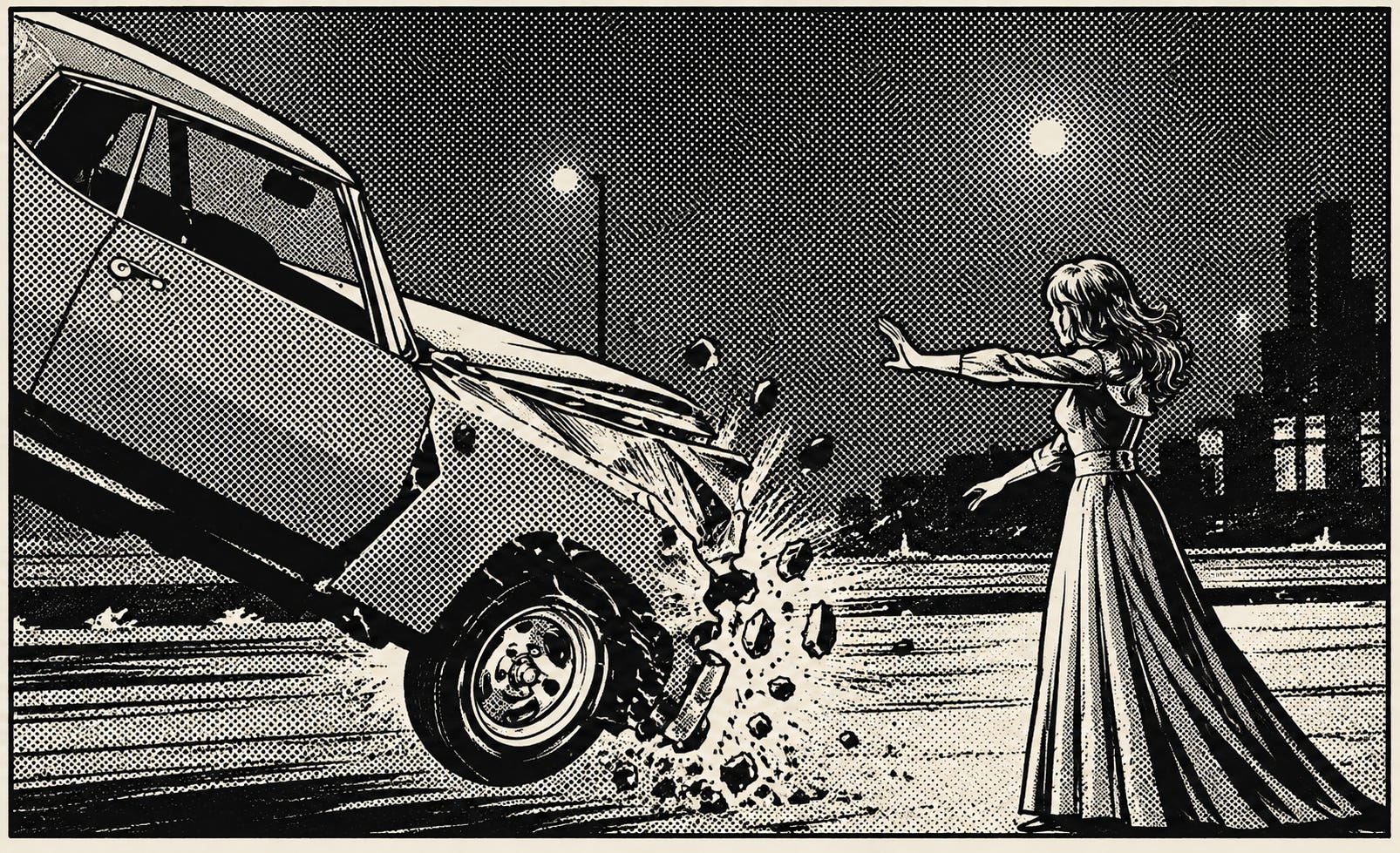
Some readers have written to ask what I think of the new streaming series “Carrie”, based on the Stephen King novel, made doubly famous by the great Brian De Palma movie of 1976. The plot is well-known: a teenage girl, on the verge of puberty, begins to manifest telekinetic (or psychokinetic, or “PK”) powers in reaction to bullying, with tragic effects. It seems that the new series goes some way into the history of real-world PK research, but in a way that’s slanted to serve the storyline.
I say “it seems” because I tried to watch the series but, so far, couldn’t get past the first half of the first episode. It’s just too much stereotypical teenage/high school angst for my palate; I had enough of that forty years ago, and the scars to show. In De Palma’s movie, all that stuff is compressed into less than half an hour, but whole episodes, hours and hours of it? Give me a break.
So, while recognizing that’s my problem, not the series’ (which is, as far as I know, enjoying a lot of success), I’ll leave the TV show here and offer a clear, unbiased view of what science really knows about the purported human capacity to move inanimate objects by mind power alone, without any kind of mechanical or instrumental mediation.
Just one last point before leaving “Carrie” behind. If the series distorts or cherry-picks research, it’s OK: as a semi-retired science fiction author, I know that part of the thrill of the profession is building pseudoscientific fallacies that sound solid, at least while the public is immersed in the fictional experience. Ideally, though, this should work like a magic trick: people should leave the show knowing that, as convincing as the effects were, nothing was real.
Cutting now to the chase: no known natural mechanism could create or explain PK. Of the four recognized forces of nature, only electromagnetism could perhaps be used, on human scales, to move objects without touching them, but the human body just doesn’t work that way. If we could generate magnetic fields strong enough to affect things around us, we could also detect and measure them, and we don’t. People may speculate to their heart’s content about the relationship between consciousness and reality or whatever, but to change the state of motion of something you need to apply a force, and the only way the human body can directly apply forces on things is by pulling and pushing with bone and muscle.
Historically, PK has suffered from the selfsame shrinking effect size that affects all other kinds of paranormal/supernatural phenomena: in the 19th century, we had people who seemed capable of making furniture dance around the house or even levitating themselves out of a third-floor window; today, a parapsychologist would call a press conference and dream of Nobel Prizes if they could find someone capable of flipping a coin, or spinning a needle, without touching it.
This shrinking has happened alongside the growth of scientists’ acumen in detecting fraud, identifying coincidences, and isolating illusions, a parallelism some mean-spirited people (like me) find highly suggestive. In the final decades of the last century, research strategy shifted significantly from “macro-PK” (observable, clear-cut, macroscopic effects) to “micro-PK” (small effects that accumulate statistically and ambiguously, sometimes at the quantum level).
This progression fits nicely into Irving Langmuir’s “pathological science” model. Nobel laureate Langmuir defined pathological science, in a historical lecture in the 1950s, as research programs “where people are tricked into false results by a lack of understanding about what human beings can do to themselves in the way of being led astray by subjective effects, wishful thinking, or threshold interactions.” The first two characteristics of pathological science, as defined by Langmuir, are:
1. The maximum effect that is observed is produced by a causative agent of barely detectable intensity, and the magnitude of the effect is substantially independent of the intensity of the cause.
2. The effect is of a magnitude that remains close to the limit of detectability; or, many measurements are necessary because of the very low statistical significance of the results.
This nicely describes the whole micro-PK program. But why was the macro-PK program mostly abandoned? If you look in the literature, you’ll find some epic rhetorical footwork about unreliable and/or unpredictable effects, difficulty finding suitable subjects, etc., but the bottom line is: fraud. Not to put too fine a point on it, every time a purported macro-PK operator is tested under conditions that preclude clever magic tricks, the effects stop.
The examples are overwhelming, from Uri Geller failing to perform on the Johnny Carson show in 1973, when the test conditions had been prepared by conjurer James Randi, to the case of British experimental physicist John Hasted, who proclaimed he had found children capable of bending metal with their minds—only to be later exposed as a victim of pranks played on him by the kids. Too many instances to mention: John L. Wilhelm’s 1976 investigative book The Search for Super-Man is a beautiful exposé of how Geller and others kept some overeager scientists entranced, while researchers schooled in magic and trickery saw right through their petty charades.
Does it mean that every single self-proclaimed PK operator in history has been caught red-handed, cheating? Of course not. Sometimes it happens, but most of them are too wise for that. Nonetheless, when conditions make trickery too hard or impossible, their powers vanish. You could argue, and some supposedly very smart people with PhDs and all the trimmings have argued, that the same conditions that preclude fraud also block psychic energies, but to me, that sounds too much like the joke about the invisible man whose power works only when nobody is looking straight at him.
Which brings us to Nina Kulagina, the Soviet PK star who, I am told, is featured in one episode of the “Carrie” series. The choice of Kulagina makes sense in an audiovisual narrative context: some very impressive Soviet-era footage shows her doing amazing things. It’s even likely that Kulagina's movies, after they leaked to the West in the late 60s/early 70s, influenced the CIA's decision to investigate paranormal phenomena, starting in 1972 (there’s even an American declassified intelligence report that mentions her several times).
The influential 1970 book Psychic Discoveries Behind the Iron Curtain, a best-seller by Sheila Ostrander and Lynn Schroeder that also helped spur American military investment in paranormal research, sensationalistically describes movies of Kulagina’s feats that the authors watched during a Moscow parapsychology conference in 1968. The problem, again, is that conditions were too lax to allow anyone to take her doings at face value. As Italian skeptical investigator Massimo Polidoro writes:
As for Nina Kulagina, the conditions under which she operated were far from acceptable from the view of basic scientific standards. Tests were frequently carried out at her own home or in hotel rooms; no tight controls were ever applied (….) Also, when anyone who has a background in magicians’ techniques watches these films, they cannot avoid the feeling that she is using standard conjuring techniques: a magnet hidden on her body to move the compass needle; a thread or a thin hair to move objects across the table; a small mirror concealed in her hand to read signs with numbers and letters being held behind her. Unfortunately, no expert in conjuring techniques was ever present at Kulagina’s demonstrations.
The chapter on Kulagina in Psychic Discoveries, credulous as it is, also offers some inadvertent clues: when tested in a laboratory, the psychic needed several hours (from two to seven!) of “concentration” before manifesting any effect — time enough, one may surmise, to get the scientists around tired, bored, and distracted. She also became very tired very quickly and seemed to be in some pain while performing her PK. In more informal, less controlled settings, however, like her own home or a restaurant, Kulagina not only smiled happily while producing her phenomena; sometimes, objects moved and danced with ease around her, like so many magical pieces of china and cutlery in a Disney musical.
Psychic research in the Soviet bloc has a long and fascinating history. Pseudosciences in the West are driven mostly by market forces—the sale of magical cures, self-help schemes, sensational books, and documentaries—but in the Soviet world, the pressures were both strategic (psychic weapons! mind control!) and ideological: the official party line of atheism demanded “natural” explanations for extraordinary phenomena, if such phenomena were to be contemplated at all. Even so, the definition of “natural” could be stretched significantly, going to include mysterious “bioenergies.” A research paper puts it candidly:
Although the Soviet state and its satellite states were supposedly based on solid dialectical materialistic principles (whatever that means), they in fact had a keen interest in paranormal phenomena. In most of the cases, they were motivated by the curiosity to find out how hitherto unknown forces of nature could be used to rout out the enemy, both external (the “imperialists”) and internal (“deviant” people), and they were ready to devote financial resources to this aim. A number of works on this topic focus on hearsay about the superstitiousness of party leaders after Stalin. These leaders exploited occult phenomena and took them seriously, while this possibility was denied to their subjects. In the hospital of the Kremlin, bioenergy experts were employed, especially to cure Brezhnev …
Brezhnev, of course, is Leonid Brezhnev, the Soviet leader who died in 1982 after more than a decade of increasingly serious health problems brought about by heavy smoking, insomnia, and obesity. A stroke, the second in a series, reportedly left him clinically dead for a while in 1976.
Psychokinesis is one of those phenomena that fall under what I have called “The Houdini Principle”: If an occurrence has two possible explanations, one that requires a complete overhaul of the laws of physics and biology and another that conforms to those laws but is socially awkward (because accepting it may imply that someone is being dishonest or incompetent), in the absence of decisive evidence, the second one must be preferred.