

There’s this old joke that’s one of my favorites, and I probably have used it as an allegory in my writing more times than my long-suffering readers deserve, but here it goes again: a guy jumps from the 100th floor of a skyscraper. When his falling body passes by the window of an office on the 20th floor, he looks inside, smiles, and cries to the bewildered people there: “Don’t worry! So far, so good!”
Let’s put the humor aside for a moment and analyze the situation in some depth. Here we have a person who’s on a trajectory that, according to unwavering laws of physics, human biology, and basic probability, will lead his life to an inevitable — and spectacular — end in a very few seconds. But the empirical evidence he has at that precise moment in time, during his passage by the 20th floor, is that, perhaps except for the slight gut discomfort of freefall, he’s pretty okay.
And that’s what he goes with: he isolates that moment from any relevant context or extraneous information. He censors everything but here and now. No implications, no connections, no deductions or extrapolations. Hence, “so far, so good”.
Of course, given that the problematic, and very kinetic, meeting with the sidewalk is going to happen anyway, perhaps that's the healthier thing that the poor man can do. But what if someone on the 80th floor had offered him a parachute? Or if Superman had flown by and offered to pick him up. Would it have been rational to refuse these offers because, after all, “so far, so good?”
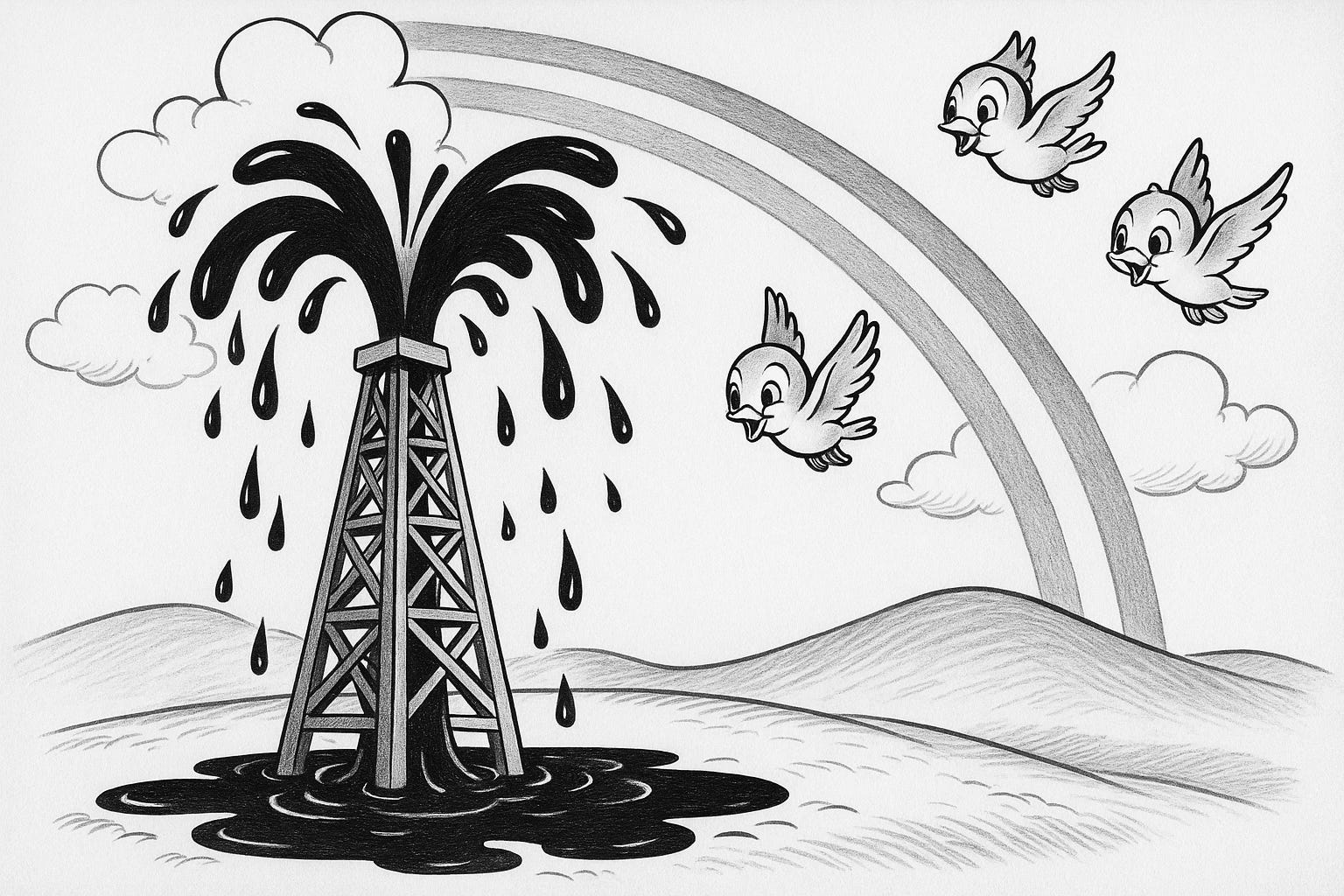
I believe that very few people would answer “yes” to the question above. However, “so far so good” seems to be on the way to becoming the new “centrist”, or purportedly “rational”, attitude towards climate change. Yesterday, it was Bill Gates who embraced the “it's not the end of the world, we have more important things to worry about” line. Last week, the Brazilian government decided to open new oil fields.
The fact that the areas involved are in the Amazon has some irony built in, but the main point is that huge investments will be made to add more carbon to the atmosphere, at a moment when sheer environmental sanity would urge just the opposite. President Lula said that the Amazon oil money will help pay for the energy transition. This has the same logic as stimulating the sales of cigarettes, promising to use the money to treat lung cancer.
Both Gates and Lula seem to be in the “so far, so good” mode. Of course, the climate situation is more nuanced than that of our optimistic jumper — he’s in a joke and we are in reality, after all. Gates is right in saying that climate change “won’t cause humanity's demise”. The point is, things don’t have to be extinction-level lethal to be very, very bad.
The fact is that our present global civilization flourished thanks to a series of environmental conditions that climate change is disrupting — and, yes, we (as a species) can adapt to new conditions, but how much of civilization we can take with us, and at what cost, is an open question. Gates now says that concern with CO2 emissions and temperature goals is diverting resources from the fight against more urgent causes of human misery. So, we should reprioritize.
This atomizing approach, of treating each challenge as a perfectly discrete problem, ignores synergistic effects: trying to fight, say, malaria without accounting for the fact that rising temperatures will make the malaria mosquito at home in more and more parts of the world would be like pouring water into a sieve. The same goes for opening new oil fields to fight poverty (oil wealth, one hopes, would create jobs and the like): climate change, stimulated by CO2 emissions, will generate poverty by forcing people to spend on mitigation and, even, to migrate, with all the social and political tensions that go with population displacement.
The atomizing approach is at the heart of the “so far, so good” attitude: a focus on immediate, partial metrics, wilfully ignorant of trends, contexts, and predictable long-term consequences.
Where does this rhetoric come from? I think that’s a discourse world leaders are testing — with no small stimulus from the old-energy, greenwashing, we-want-to-transcend-oil-but-let’s-drill-just-once-more sector — as a way to deflect criticism of what is gearing to be a very frustrating, lackluster climate convention, the COP-30 in Brazil.
Oil interests and short-term-focused political leaders want to get rid of unpleasant commitments and verifiable goals, replacing them with vague mouthings on “development” and “concerns” (to declare oneself “concerned” with something while letting it happen right under one’s nose is a tried-and-true tactic). These shenanigans should be denounced and resisted.