

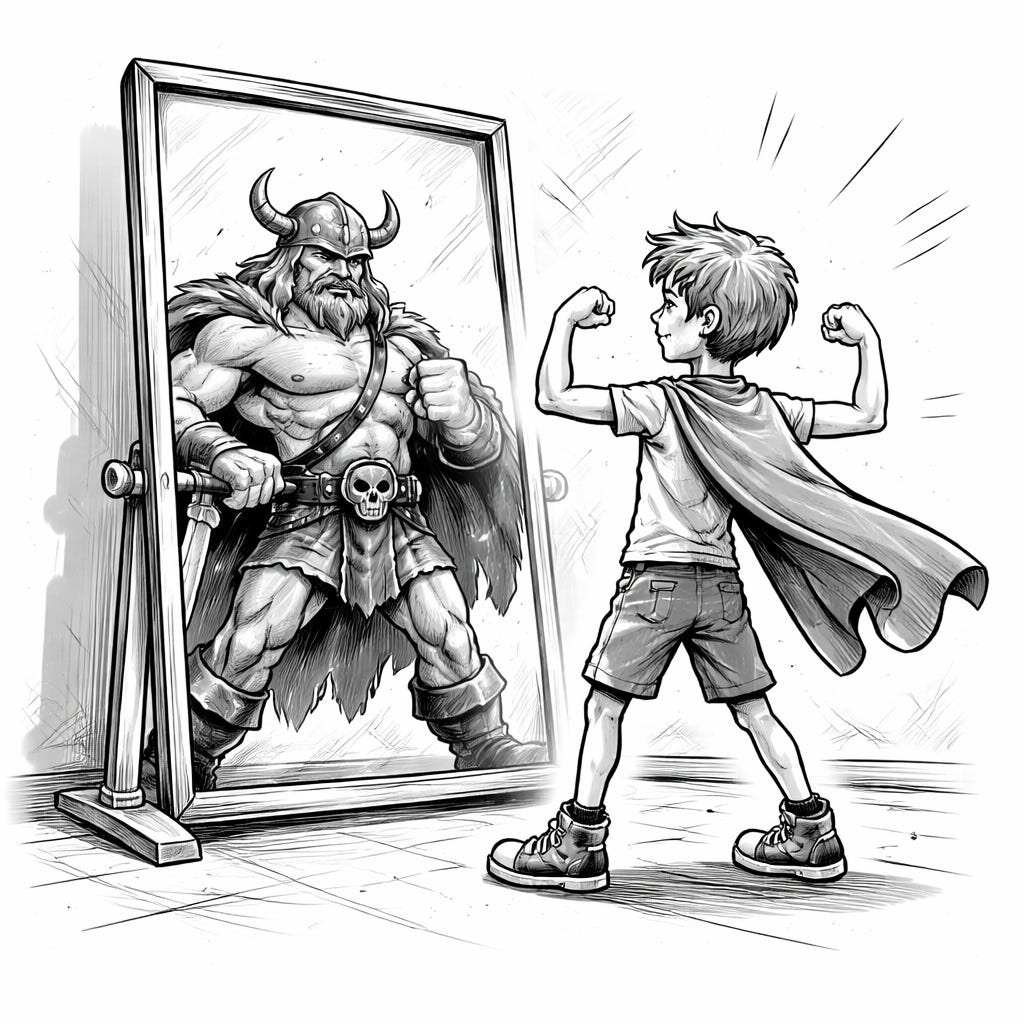
People sometimes adopt or embrace beliefs not because they know them to be true or, at least, supported by the preponderance of the available evidence, but because believing certain kinds of stuff makes them feel good about themselves and the world. It’s nice to believe that one’s talented, that one’s goals in life are worthwhile, that our favorite political leader is the Great Helmsman of the Nation, that there’s a Higher Power looking after us.
The discovery of this brute fact of human psychology has, historically, caused two opposite reactions: one, that might be called fideist (from the Latin fides, “faith”), is one of acceptance. Fideists say, okay, emotional comfort and psychological stability may very well be good grounds for keeping a belief: if it works for you, go for it. The other, the skeptical reaction, is one of alarm: if feelings, not evidence, can cement belief, you must always be vigilant not to let it happen. For fideists, feel-good-based belief is a feature; for skeptics, it’s a bug.
It wouldn’t be wrong to say that most of us are quasi-fideists: full of beliefs that are there only because they make us feel good, superior, comfortable in our skins and in our tribes, or just because they prevent the perceived coherence of our subjective realities from falling apart.
But, crucially, very few people would define themselves as pure-blooded fideists. There is something phony, blatantly self-serving, in admitting that one endorses a belief only because it feels like a warm, furry blanket for the soul. And there are the radicals: Thomas Henry Huxley was once quoted as saying that those “pretending to believe what they have no reason to believe, because it may be to their advantage” had “reached the lowest depths of immorality.”
If someone presses us on our own vanity/comfort beliefs, we’ll probably defend them with the best “evidence” we can find, no matter how flimsy, biased, cherry-picked, misrepresented, or just plainly false it may be. What stops us from being full-fledged fideists is this need to present evidence, even if contrived: it’s because common sense tends to agree with T. H. Huxley — at least up to a point.
There are, however, those who’d argue for a sheer fideist approach, skepticism be damned. This line of reasoning is usually, but somewhat unfairly, traced back to philosopher William James’s essay The Will to Believe.
The tracing occurs because, in the essay, James defends the idea that dispositions of feeling may provide a valid basis for belief in the absence of evidence. It is a little unfair because James makes some effort to limit this authorization to cases in which the balance of the evidence is inconclusive. In other words, he defended believing things in the absence of favorable evidence, but if, and only if, the evidence against them wasn’t compelling.
Even this mitigated form has problems, both philosophical (is it really true that only a coin toss separates default skepticism from default credulity?) and practical: the idea that the absence of negative evidence, plus emotional affinity, suffices for legitimate belief opens the floodgates for all kinds of sophistry and equivocation in the weighing of evidence, including perverse manipulations of the principle of the burden of proof. The whole profession of the merchants of doubt is born here.
Even if it’s “a gross misreading,” as Edward H. Madden wrote in his introduction to the Harvard edition of The Will to Believe, to say that James “advocated believing whatever one wants if so doing makes one happy or has any need-fulfilling results,” it cannot be denied that he brought — both in that essay and in several other writings — a patina of respectability to the notion that a belief ought to be judged not necessarily by its correspondence to reality, but also by its perceived subjective benefits.
As he wrote in his last essay on spiritualistic phenomena, commenting on his late friend and psychic investigator Richard Hodgson, who became convinced that the dead spoke through mediums: “When a man’s pursuit gradually makes his face shine and grow handsome, you may be sure it is a worthy one.” It really sounds like an endorsement of “believing whatever one wants if so doing makes one happy or has any need-fulfilling results!”
A sort of stealth version of sheer fideism has always been with us. As Michel Foucault wrote in Society Must Be Defended, for the political activist only truths that advance the cause are of any interest; the warrior-politician regulates their beliefs according to their political passions, and the evidence is tortured to say whatever may be deemed necessary. The corporate world is no different.
In recent years, however, the decorum that made full-fledged fideism try to disguise itself as quasi-fideism, to present its emotional commitments as a posteriori and not as a priori to the evidence, has been blown to bits. In fields from healthcare and wellness to international relations, “I believe it because I like it” is now seen by many as a solid argument. Not even the sciences are fully immune.
Such an intellectual fashion should be resisted while there’s still time.