

‘Tis Halloween season!
So, throughout the month, I’ll try to keep the newsletter as spooky as it is informative (and some of the juicier parts of the material will be paywalled… I need my treats!). If you enjoy my longer historical essays, consider becoming a paid subscriber: researching and writing these pieces is a delight, but it takes time and resources.
We begin with a survey of the present state of the supernatural world…
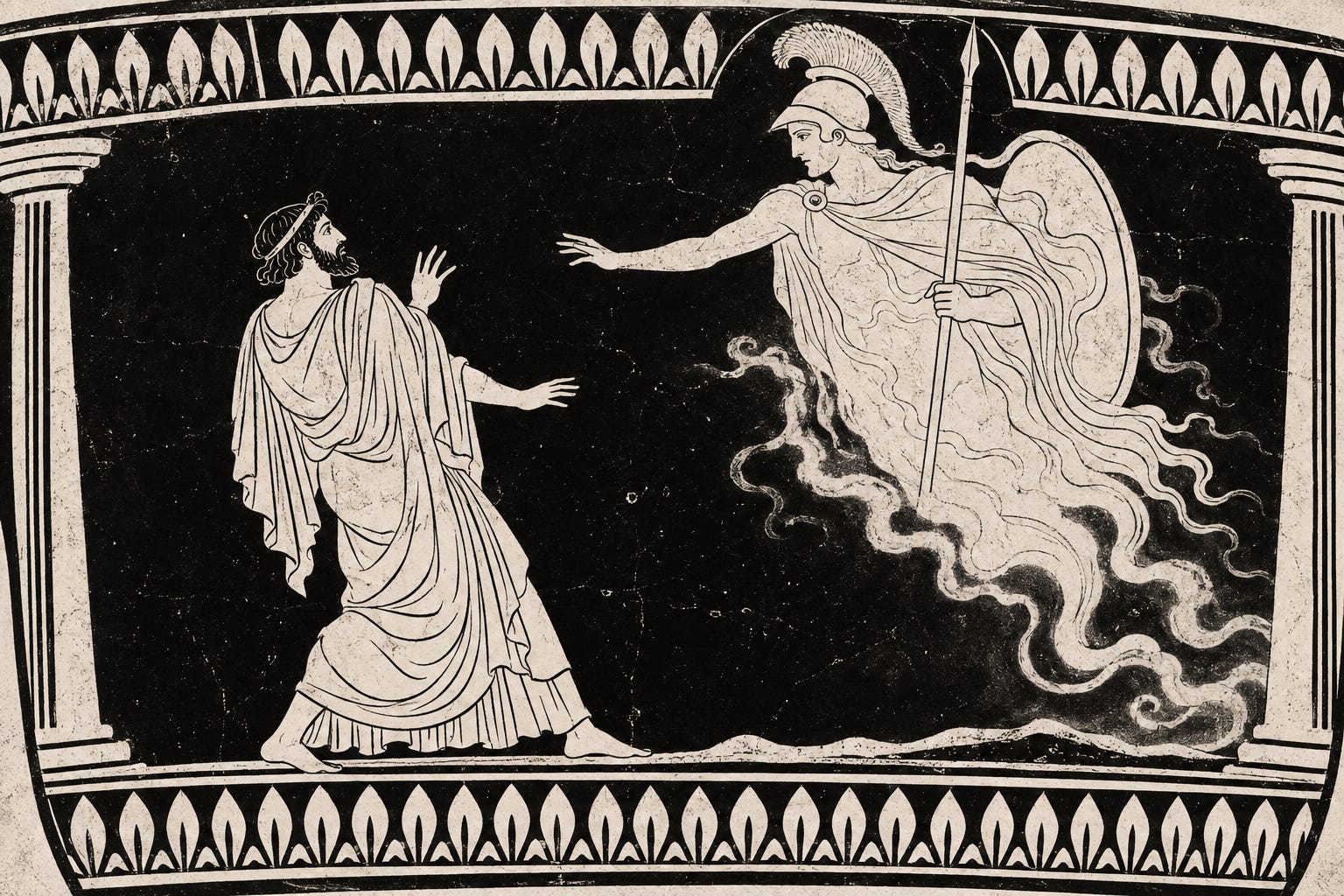
When the magician-philosopher-prophet Apollonius of Tyana, in the first century of the Common Era, summoned the spirit of the demigod Achilles, who had fallen in battle more than a thousand years earlier during the siege of Troy, the ground shook. Then Apollonius saw a heroic figure appear before him, five cubits (or more than two meters) tall, who soon expanded until he reached twelve cubits, or more than five meters. The monumental Achilles then asked Apollonius to remind the Thessalians of the need to offer him funeral sacrifices. The two conversed until sunrise, when the epic ghost vanished in a flash of lightning.
Twenty centuries later, the most we can get out of ghosts is blips on magnetic-field detectors, gusts of cold air, and indistinct whispers picked up by recorders left running in empty rooms or by deliberately mistuned radios. Which does not seem like much. But, apparently, it is enough to draw audiences to cable TV shows and YouTube channels.
In the book Debunked!, Nobel Prize–winning physicist Georges Charpak (1924–2010) and physicist and professor of scientific methodology Henri Broch present a graph plotting the mass of objects allegedly moved by telekinesis (that is, by the power of the mind or spirit) against the passage of time. The distribution is interesting.
A thousand years ago, the willpower of mystics, spirits, or psychics would supposedly have been enough to move the moai of Easter Island, each with a mass on the order of ten tons.
In the 19th century, this power could levitate pieces of furniture and adult human beings; by the mid-20th century, it could alter the outcome of dice throws and send bricks, glasses, ashtrays, and other household objects flying during poltergeist episodes. In the 21st century, if we are lucky, it lowers the temperature of empty rooms by a few degrees or, every once in a great while, affects the random distribution of subatomic particles.
As Charpak and Broch wrote, “the body of observed supernatural phenomena shrinks like a wool sweater in a clothes dryer.”
Decline
The authors note that this loss of power correlates almost perfectly with the increase in the quality, quantity, and precision of objective means of detection. It is an analysis that seems to apply to the entire range of phenomena traditionally classified as “paranormal.” Commenting on the apparently insurmountable difficulty of obtaining clear images of alien spacecraft and their occupants, for example, has become a cliché—even in an age of digital cameras in cell phones and space telescopes capable of detecting galaxies billions of light-years away.
The oldest recorded “true story” of a haunted house in the West involves the Greek philosopher Athenodorus (74 BCE–7 CE), who had rented a house in Athens for an extraordinarily low price—precisely because no one was willing to live there, for fear of a ghost that roamed the house at night, dragging chains.
According to Pliny the Younger (61–c. 113), Athenodorus was writing at night when the apparition came to him, perfectly visible, producing the loud and unmistakable sound of chains striking and scraping along the floor (”a specter… an old man, emaciated and squalid, with a long beard and bristling hair, rattling fetters on his legs and chains on his hands… beckoning with his finger, inviting him to follow”). He regarded it calmly and followed it into the garden, where the restless spirit vanished. The next day, he had the garden excavated and found bones and chains buried there.
Once the skeleton received a proper funeral, the haunting ceased.
Let us review the conditions under which the apparition occurred: the philosopher was alone; the room was illuminated (it was night, but there was enough lamplight for Athenodorus to read and write comfortably); the ghost was seen, heard, and communicated—even if only through gestures—with perfect clarity.
Jump forward to the 19th century, and physical manifestations—visible, audible, tangible, like the Athenian ghost—when witnessed by more than one person, occurred only in complete darkness. And now, in the 21st century, with infrared cameras, motion detectors, and digital recorders, all that can be obtained are ambiguous signals, random fluctuations, and vague subjective impressions (“emotional heaviness,” “bad energy,” etc.).
In terms of communication with spirits, the loss of efficiency between the ghost of Athens and those inhabiting today’s haunted houses is striking. And if we recall the ease with which Apollonius conversed with the ghost of Achilles, there is simply no comparison—literally.
Rise
One explanation traditionally proposed for the decline of paranormal effects in exact proportion to the increase in our chances of detecting and verifying them (if they are real) is that today’s skeptical, materialistic, faithless world makes such manifestations less likely and less impressive. In other words, we have become unworthy. This is not a new hypothesis: it already appeared, for example, in a discussion by Plutarch (c. 50–125) about the disappearance of the oracles of the ancient world.
But the idea founders not because it is old, but because its premise is false. Belief in the unbelievable is not declining; it is rising. According to the 2018 Paranormal America survey of Champan University, the proportion of Americans who believe that “places can be haunted by spirits” rose markedly in just two years, from 46% in 2016 to 52% in 2017 and 55% in 2018.
The trend had already been detected at the beginning of the century by a Gallup survey, which recorded a 13-percentage-point increase (from 29% to 42%) in the proportion of Americans who believed that “houses can be haunted,” between 1990 and 2001. A YouGov poll conducted just before Halloween 2021 found that 41% believed in ghosts and 43% believed in demons.
Writing probably in 2000 or 2001 (the original French edition of Debunked! appeared in 2002), Charpak and Broch attributed the mismatch between evidence and belief to the influence of the media and to what they saw as a transformation in the principal way people absorb information: “an explosion of visual images with emotional impact and a decline in writing and rational analysis,” something they also regarded as a threat to democracy—and this was well over a decade before TikTok.
Anyway…
The most parsimonious explanation for the dramatic loss of paranormal power over the past two centuries is, of course, our increased ability to identify illusions and detect fraud.
When only one person sees the ghost, it manifests itself freely and in full light. It can even change shape—Lucian of Samosata (c. 125–after 180) tells the story of a spirit that tried to frighten a Pythagorean philosopher by transforming itself into a dog, a bull, and a lion.
When there is a committee waiting for it, however, absolute darkness becomes necessary.
When the question is how gigantic rocks were moved hundreds or thousands of years ago, people speculate about the powers of the mind. When attempts are made to document those powers in the present, under controlled conditions, all that remains—when anything remains at all—are statistical anomalies in microscopic systems.
When only one or two people are around, the flying saucer lands, the aliens make contact and deliver messages. When a crowd is watching, at most a few lights blink in the distant sky. When the photographer and reporter are alone and have only a camera loaded with black-and-white film, the image shows a perfect silver disk; when there are digital instruments and countless observers, it is nothing more than a blur on a screen. And so on.
These occurrences deserve to be called marginal phenomena—not because they exist on the margins of science or society, but because they manifest themselves only within the margin of error of our detection systems and our capacity for interpretation. As the margin shrinks, the effects diminish.
But the margin will never be zero, and belief in marginal phenomena—with occasional surges, depending on the historical and psychological context—will probably always be with us, as will the opportunists interested in making money by exploiting those who cling to such beliefs.