
"Stop waiting for permission"
The deep sscrets of oracular pronouncements

Stop waiting for permission to want something different. That’s the advice astrology app Co-Star had for me last Monday, the day I started writing this article. As a piece of oracular rhetoric, it’s brilliant: it’s vague to the point of meaninglessness, alluding to things neither explicit nor implicit in the text (permission from whom? something different from what?), but this same vagueness will guarantee that many people will read it as deeply personal—the app’s users know what their particular inhibitions are, after all, and will unconsciously fill in the gaps, and then be amazed by the advice’s pointed precision and pertinence.
It also bears noting that, as far as oracular pronouncements go, this one is rather bland and safe: it tells one to stop waiting for permission not to do something, but to want something. It doesn’t say anything about not asking permission before acting on that want. After all, who knows what crazy desires people may have? Careful there, kids!
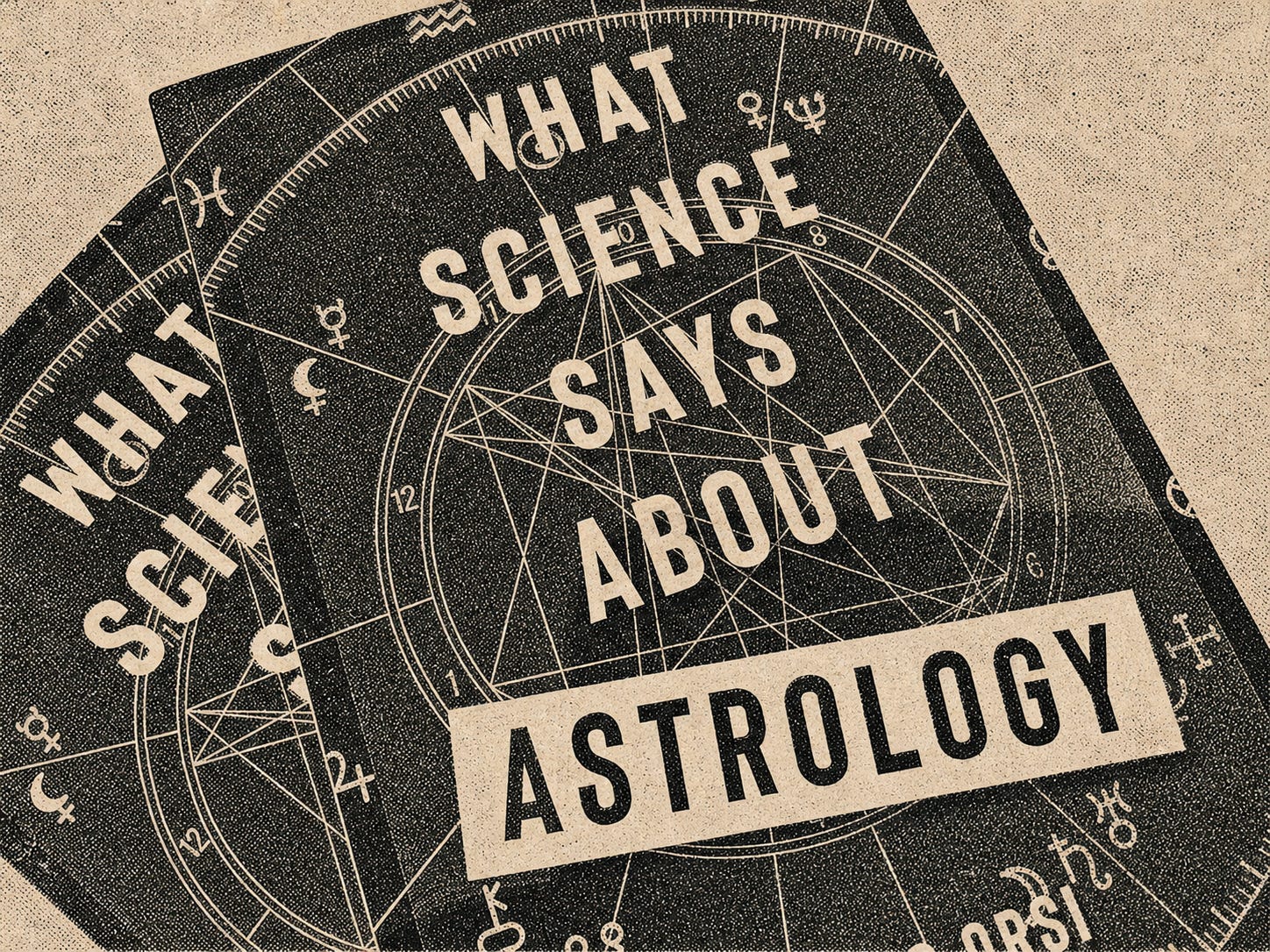
Frequent readers of this space already know that my book from Columbia University Press, What Science Says About Astrology, is coming out May 19. (You can get it directly from the publisher by following this link. If you go there and use the code CUP20, you may even get a discount. You can also get it from Amazon, IndiePubs, Barnes & Noble, and other places.) One thing people ask me every so often is why bother debunking something like astrology. After all, it’s not like, say, the spurious and totally fictional vaccine-autism “link.” Nobody is suffering or dying because of their horoscope. Right?
My first answer is that people who are genuinely curious about a subject, be it vaccines or black holes or horoscopes, have the right to find good and reliable information on the subject—and the marketplace of ideas is so chock-full of misleading stuff about how wonderful astrology supposedly is that a debunking book is really just a minor effort in trying to balance the scales.
The second answer is that, wrong, as a matter of fact, people may suffer or die because of horoscopes or, more broadly speaking, from taking astrology in general seriously. Tiberius, the second Emperor of Rome, had hitmen going after people whom he believed, because of their horoscopes, could menace his power. Nowadays, there are people making decisions about when to give birth or whom to hire based on astrological considerations.
It is true that oracular utterances, like the one that opens this article, can seem innocuous, fun, or even useful, in a thought-association-exercise kind of way: as they are totally open-ended, what they really do is give one something to consider—the seed of an idea, a prompt, if you will: a nugget that can develop into a curious train of thought, a legitimate insight, or nothing at all. What’s the harm there?
Not every astrological pronouncement is oracular, however: some, like those around the feared Mercury retrograde periods, are quite definite. Besides, oracular sentences are not as innocuous as one might think: received as coming from a source of wisdom or authority, they communicate such authority to the conclusions they inspire, and a proposed course of action born of nothing more than random musings may be seen as endorsed by higher powers, even when cold logic suggests it may lead to catastrophe.
And oracles, of course, are unimpeachable: as the numerous anecdotes about the most famous of all, Delphi in Ancient Greece, show, every time someone flounders by following oracular advice, the blame is placed on the victim, who is said to have failed to interpret the message correctly. That’s the most glaring characteristic of divination systems, be it astrology or anything else: they get the credit when things go right, but not the responsibility when they go wrong.
Astrology today is big business. Co-Star made national news after raising $ 15 million from investors at the begining of the decade, and the global market for astrological services is expected to grow to $ 23 billion by 2031. So, why the book? Among many other things, because people have a right to be well informed before deciding to pay for something — and, if they decide to go for it, to know what they are paying for.