
Newtonian gods
Before "scientific" creationism in biology, there was "natural" theology in physics

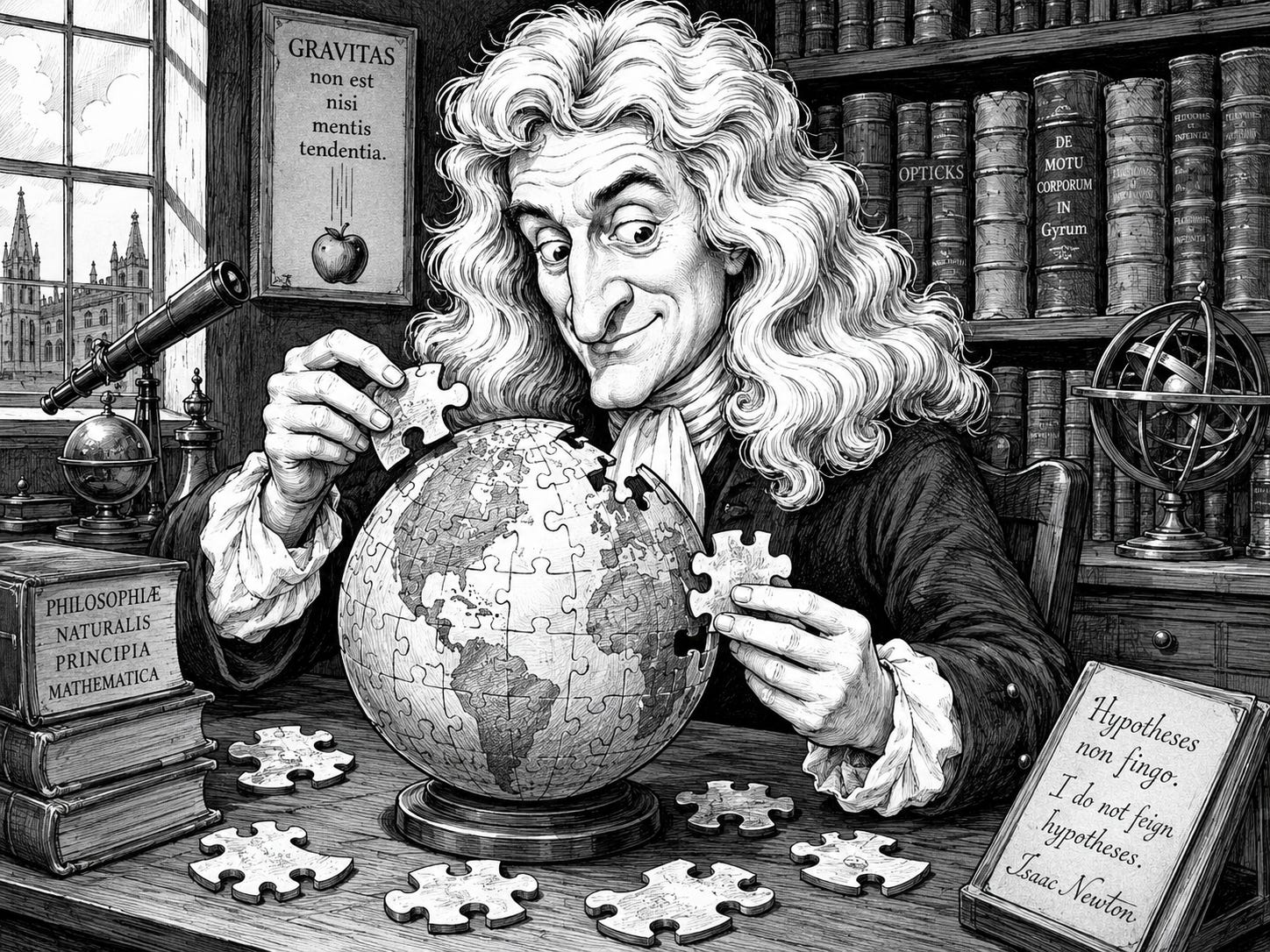
One thing to know about bad ideas is that they are like weeds in a garden: no matter how sure you are you've gotten rid of them, or how long they stay away, sooner or later they will pop up again. “Scientific” creationism and its more generic form, natural theology—the belief that one can use scientific facts to prove religious dogma—is one of them. Nowadays, this kind of stuff tends to hijack and distort biology and geology (“Intelligent Design,” anyone?), but long before the reaction to Charles Darwin (1809–1882), they tried to do something similar to physics.
In 1796, French astronomer and mathematician Pierre-Simon Laplace (1749–1827) proposed his Nebular Hypothesis, a model for the origin of the Solar System grounded exclusively in Newtonian celestial mechanics and probability—a genesis story predicated only on science and mathematics, without requiring divine action, intention, or intervention.
According to a well-known anecdote, when Laplace was asked by Napoleon Bonaparte (1769–1821) why his works on astronomy did not mention God, he answered, “Because I have no need for this hypothesis.”
No contemporary documentation confirms the exact words of the exchange, but the diaries of astronomer William Herschel (1738-1822) register the Laplace-Bonaparte meeting and the gist of the conversation. A century later, social scientist Max Weber (1864–1920) would write about “the disenchantment of the world,” the modern age in which “technology and calculation” replace magic and prayer.
Ironically, all these developments would have appalled the man most responsible for the eventual enthronement of “technology and calculation,” Sir Isaac Newton (1643–1727). Newton and the intellectual circle that formed around him were staunch Protestant Christians (albeit, at least in the case of Newton himself, of a very unorthodox bent) who believed that the newly discovered laws of mechanics showed that the “Book of Nature”—that is, scientific observation—revealed God’s truth as plainly as Holy Scripture.
When theologian and classics scholar Richard Bentley (1662–1742) used Newtonian principles to underpin a series of religious sermons in 1692, Newton famously commented that “When I wrote my treatise upon our Systeme I had an eye upon such Principles as might work with considering men for the beliefe of a Deity and nothing can rejoyce me more than to find it usefull for that purpose.”
The members of the first generation of Newtonian intellectuals were not only adepts and proponents of natural theology, but also theological voluntarists: they saw a God who imposed His will on the universe in real time, always present and active in His Creation, always adjusting and interfering to impede base matter from collapsing into decay and inertia. He was pantokrator, the arbitrary and absolute ruler of the cosmos.
In the Newtonian view, matter is simple vis inertiae, and without continuous divine intervention the Universe would ultimately grind to a halt.
Because of that, the Newtonians would engage in a long and acrimonious polemic with German philosopher Gottfried Wilhelm Leibniz (1646–1716). Besides disputing the priority in the invention of integral and differential calculus with Newton, Leibniz also proposed a God who, having created “the Best of All Possible Worlds,” would have no reason to keep meddling with His work: a perfect Creation (and God could do nothing less than perfect), once realized, should be self-sufficient. For Leibniz, a God who must needs adjust or sustain His oeuvre continuously after completion would be less than competent; for Newton, a God who never interferes would be impotent.
Each considered the other’s position untenable and offensive. In a letter later published by the noted theologian (and Newtonian) Samuel Clarke (1675–1729), Leibniz complains that, according to Newton and his followers, “God Almighty needs to wind up his watch from time to time… He had not, it seems, sufficient foresight to make it a perpetual motion.”
The theological dispute affected even the scientific models of physical reality proposed by each camp. The Newtonians argued that force—something imposed from outside that could be neutralized or extinguished, as when two moving spheres collide and come to rest—was the fundamental measurable quantity involved in a material body’s movement, while the Leibnizians argued instead for vis viva, seen as an intrinsic and indestructible property of matter itself.
